
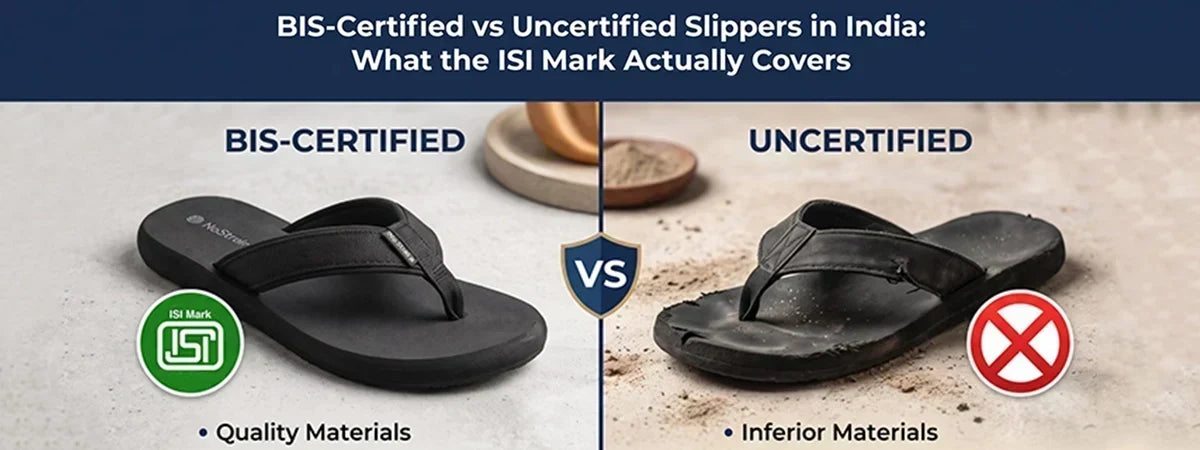
BIS-Certified vs Uncertified Slippers in India: What the ISI Mark Actually Covers
Most slippers and sandals sold in India are supposed to carry an ISI mark under IS 6721:2023, the Bureau of Indian Standards specification for sandals and slippers. It replaced the older IS 11544:1986 rubber-slipper standard in 2023, and covers every variety of sandal or slipper, fully moulded or assembled, sold in the country. The mark means the pair has been tested for things like tear strength, bond strength between the sole and upper, abrasion resistance, and how the sole holds up to moisture over time. New production has needed this mark since 1 August 2024, though a stock-clearance window still lets some older, declared inventory sell without it.
Is BIS certification mandatory for slippers and sandals in India?
Yes, for anything made after 1 August 2024. BIS/ISI certification for footwear used to be voluntary. The government's Footwear Quality Control Orders (QCOs) changed that: one covering leather and other materials, one covering rubber and all-polymeric footwear. Sandals and slippers, including IS 6721:2023, fall under the rubber/polymeric order, which took effect on 1 August 2024 alongside the leather order.
There's a wrinkle worth knowing about. Manufacturers and importers who had uncertified stock made before that date could declare it to BIS and keep selling it under a grace window. That window has been extended twice since, most recently to 31 July 2027. So some pairs on shelves right now are legitimately uncertified old stock, not necessarily non-compliant, while anything freshly manufactured has no such exemption and needs the ISI mark from day one.
What that means practically: a manufacturer can't legally produce a new slipper without a BIS licence for it, unless they fall under the declared old-stock exemption. As of the most recent BIS circular on this standard, over 550 manufacturers hold an active licence for IS 6721:2023, up from roughly 320 just two years earlier, which gives a rough sense of how much of the industry has actually caught up versus how much hasn't.
The rules look settled now compared with a year ago. On 12 June 2026, DPIIT amended both footwear Quality Control Orders and moved the legacy-stock clearance deadline from 31 July 2026 to 31 July 2027. Declared old stock can still be sold until then, and after that date only BIS-certified footwear can be sold. The sandal and slipper standard itself, IS 6721:2023, has applied since 1 August 2024. For a buyer, the check has not changed: look for the ISI mark and the licence number on the pair before you pay. NoStrain states that its footwear is made at BIS-certified factories, and our guide to NoStrain’s comfort and certification approach explains how that fits with the arch support and sole design. If you want to see it in actual pairs, browse the angular slippers for men or the Men’s Platform Sandals Black (PS1). Grip matters as much as the mark in the rains, so our 2026 monsoon guide to waterproof sandals is a useful next read.
What does IS 6721:2023 actually test in a sandal or slipper?
The standard doesn't just check that a slipper looks finished. It sets pass/fail requirements across several areas:
| What's tested | Why it matters to the wearer |
|---|---|
| Tear strength of the upper | Whether the strap or upper material rips under normal wear |
| Bond and attachment strength | Whether the sole separates from the upper, or a strap pulls loose |
| Abrasion resistance (dry and wet) | How fast the sole wears down, especially on wet floors |
| Hydrolysis resistance | Whether a PU sole degrades and crumbles after repeated exposure to moisture |
| Flexing endurance | Whether the sole cracks after repeated bending, not just on day one |
| Slip resistance | Grip on the tested surface |
These aren't marketing claims. They're lab thresholds set out clause by clause in the standard, and a batch either meets them or doesn't get the licence renewed.
Are uncertified slippers without an ISI mark unsafe?
Not automatically unsafe, but untested. A slipper without the ISI mark hasn't necessarily failed these tests; it may simply never have been through them at all. That's the real gap. No BIS-recognised lab has checked the sole bond, no one has verified the PU won't crumble in six months of monsoon use, and there's no licence number tying the batch back to a specific manufacturer who can be held accountable if it fails. This is common with slippers sold by weight or by the dozen in unbranded local markets, and with some newer D2C listings that haven't gone through certification yet.
How to check if a pair of slippers is genuinely BIS certified
Look for the ISI triangle mark on the footwear itself, along with a CM/L licence number. That number is verifiable on the BIS website against the manufacturer and the specific standard it covers, IS 6721:2023 for sandals and slippers, a different IS number for sports shoes or safety footwear. A mark with no traceable licence number, or a licence number that doesn't match the product category, isn't a valid certification.
FAQs
Is BIS certification the same as ISI mark?
Yes. BIS is the certifying body; the ISI mark is the mark it grants once a product passes testing and the manufacturer holds a valid licence.
Do all slippers sold in India need it?
Any sandal or slipper manufactured after 1 August 2024 does, under IS 6721:2023. Older declared stock can still legally sell under a stock-clearance window that currently runs to 31 July 2027, so not every uncertified pair on a shelf right now is non-compliant, but every new one should carry the mark.
Does a certified slipper automatically last longer?
It means the sole bond, tear strength, and flex resistance have met a minimum lab threshold. It doesn't guarantee comfort or fit, since the standard doesn't test for those; that comes down to the individual design.
Can I check a brand's BIS licence myself?
Yes, the licence number on the product is searchable on the BIS website against the manufacturer name and standard.
Leave a comment
This site is protected by hCaptcha and the hCaptcha Privacy Policy and Terms of Service apply.