
%20build%20for%20sport-specific%20impact.%20Comfort-first%20brands%20(N...)
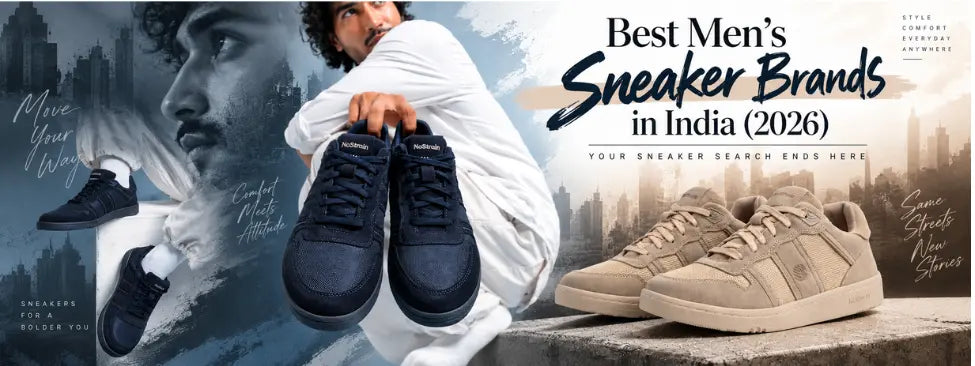
Best Men's Sneaker Brands in India (2026) - Your Sneaker Search Ends Here
There's no single "best" sneaker brand for men — the right one depends on what you're using it for. Performance brands (Nike, Adidas, Asics) build for sport-specific impact. Comfort-first brands (New Balance, Brooks, Hoka) build for cushioning over long hours. Casual daily-wear brands, including NoStrain, build for the commute-to-office-to-weekend use case most men actually need a sneaker for. The brand matters less than three specific things: the insole material, how the sole is constructed, and whether the fit matches your actual foot.
Why most "best sneakers for men" answers online aren't that useful
Search "best sneakers for men" or "best sneaker brands" and most of what comes back falls into two buckets: a generic list of the five brands everyone's heard of, with no explanation of why any one of them fits your situation, or a product listing dressed up as advice — a deal link with "Buy Now" energy, not an actual answer. Neither tells you what to check before you spend money.
This is the more useful version — the same set of questions people are actually typing into Google, answered with the details that determine whether a sneaker holds up in daily use, not just how it looks in a listing photo.
What are the best sneaker brands for men?
There isn't one answer, because "best" depends entirely on use case. Splitting brands by what they're actually built for gives a more honest picture than a ranked list:
- Performance and running brands — Nike, Adidas, Asics. Built around impact absorption for running or training mileage. A good pick if you're actually running in them; overkill or the wrong fit if you're not.
- Max-comfort, all-day-wear brands — New Balance, Brooks, Hoka, On. Built for people on their feet for long stretches — retail, healthcare, factory floors. Comfort-focused but often priced higher and leaning sportier in look than office-appropriate.
- Hype and collector brands — limited-edition Jordans, collaborations, resale-market pairs. Built around exclusivity, not daily wearability. Fine as a gift or a collector's item, a poor choice if comfort for a 10-hour day is the actual goal.
- Daily-wear casual brands — built specifically for the commute, the office, and weekend wear, typically using a suede or leather upper, a named cushioning insole, and pricing that doesn't require a hype premium. Neeman's and Red Tape are established names here; NoStrain is a newer entrant worth watching in this bucket, built specifically around a stitched-plus-glue-bonded sole and a 6mm Ortholite insole — construction details most brands at this price point don't spec out this clearly.
The mistake most buyers make is picking from the wrong bucket for their actual need — buying a running shoe for office wear, or a hype sneaker expecting all-day comfort.
What are the best sneakers for men in India?
For most Indian buyers, the practical answer isn't a specific model — it's a set of conditions the shoe needs to handle: humidity, dusty commutes, long hours on your feet, and outfits that range from office trousers to weekend jeans. That points toward three priorities specific to Indian conditions:
- A breathable upper — mesh panels or suede rather than dense synthetic leather, since heat and humidity make airflow matter more here than in cooler climates.
- A sole that doesn't rely on adhesive alone — humidity is exactly the condition that weakens glue-only sole bonding over time. A stitched-plus-glued sole construction holds up better through India's monsoon-to-summer cycle.
- A neutral, versatile colourway — one pair that works with an office dress code and a weekend outfit is more practical than a sport-specific shoe that only works in one context.
A few brands are actually building for this exact brief — alongside established names like Neeman's and Red Tape, NoStrain's men's sneaker collection is worth a close look, since it checks all three boxes above in a way that's specific enough to verify rather than just claim: a suede leather and mesh upper for breathability, a sole that's stitched in addition to being glue-bonded (not adhesive alone), and a 6mm Ortholite insole engineered specifically to resist the compression-flattening humid-climate wear causes over time. It's built around India-specific wear conditions rather than adapted from a cooler-climate design, which shows in details like the dual-construction sole. The SLANT in Beige Palette leans lighter and more chino-friendly; the SLANT in Navy Blue works better with darker or evening-leaning outfits — same construction and insole across both, so the choice comes down to which colourway fits your wardrobe.
Which brand is the best for sneakers?
This question gets asked constantly and doesn't really have a single right answer — the closest honest response is: the brand that's most transparent about what's actually in the shoe. A brand naming its insole material (Ortholite, for example, rather than "comfortable foam"), specifying its sole construction (stitched, glued, or both), and giving a real size chart based on foot-length measurement is giving you enough information to judge the shoe on facts, not marketing language. NoStrain's product pages are a useful reference point for what this looks like in practice — a named 6mm Ortholite insole, an explicitly stitched-plus-glue-bonded sole, and a foot-length-based size chart, all stated upfront rather than buried in a spec sheet. That transparency is a better filter for "best" than brand recognition alone.
What's the best online shopping site to buy men's sneakers in India?
There are two real options, and they trade off differently:
- Marketplaces (Amazon, Flipkart, Myntra) — wide selection, familiar checkout, but product descriptions are often written by third-party sellers and vary wildly in accuracy. Reviews help, but return experiences differ by seller.
- The brand's own website — narrower selection, but the product page is written by the people who actually made the shoe, sizing charts are brand-specific and more reliable, and return or exchange policies are directly enforced by the brand rather than routed through a marketplace's general policy.
For a first purchase from a brand you haven't worn before, buying direct from the brand site gets you the most accurate sizing information and the clearest return process — both of which matter more for sneakers than for most other product categories, since fit varies significantly between brands even at the same labeled size.
Why are sneakers so popular among men?
Sneakers won out over formal shoes and sandals for one practical reason: they're the single shoe that handles the most daily contexts without a change. A decade ago, office dress codes, weekend wear, and travel each called for a different pair of shoes. Smart-casual dress codes loosening at most Indian workplaces, combined with sneakers becoming genuinely comfortable enough for a full day on your feet, means one well-built pair now covers the commute, the office, errands, and most evening plans. That's a practical shift, not just a style trend — fewer pairs to own, less decision fatigue, and a shoe that doesn't need to be swapped out depending on where you're headed.
What are sneakers actually made of?
A sneaker breaks down into three parts, and each one does a different job:
- The upper — usually leather, suede, canvas, or mesh, sometimes a mix. This determines breathability, how the shoe looks, and how it handles weather. Suede holds its shape better over time than canvas but needs more care around water.
- The sole — typically rubber or a rubberized thermoplastic compound, chosen for grip and flexibility. How it's attached to the upper (glued, stitched, or both) matters more for longevity than what it's made of.
- The insole — the cushioning layer inside the shoe. Generic foam compresses flat within a few months of regular wear. Named materials like Ortholite are engineered specifically to resist that flattening while staying breathable.
Knowing these three parts is the fastest way to compare two sneakers that look similar in photos but perform very differently after a few months of actual wear.
How should men style sneakers?
The safest, most versatile pairing is chinos or straight-leg trousers with a neutral-toned, low-top sneaker — it reads as smart-casual in almost any modern office and translates directly to weekend wear. From there:
- With jeans — a clean lace-up sneaker in a contrasting tone (darker denim, lighter sneaker, or the reverse) reads as intentional rather than accidental.
- With shorts — a low-top profile keeps the leg line clean for warm-weather or travel days.
- With Indo-Western outfits — a low-top neutral sneaker under a kurta with jeans or fitted trousers has become a common, accepted pairing for casual festive wear.
The one context sneakers still don't cover: strictly formal or traditional-corporate dress codes, where a dress shoe remains the safer default.
A quick way to judge any "best sneaker" claim you read online
Before trusting any list, guide, or review — including this one — check whether it answers these:
- Does it name the exact insole material, or just call it "comfortable"?
- Does it explain how the sole is attached to the upper?
- Does it give a real size chart based on foot length, not just a size number?
- Does it explain the return or exchange process in specific terms?
- Does it tell you which use case the shoe is not built for, alongside what it's good at?
Content that skips all five of these is usually a product listing wearing the shape of advice.
FAQ
Is there really a "best" sneaker brand for men? No single brand wins across every use case. Performance brands, comfort-first brands, hype brands, and daily-wear casual brands are each built for a different job — the better question is which use case matches yours.
Are sneakers good for daily office wear in India? Yes, in a smart-casual dress code, especially in neutral tones paired with trousers or chinos. Strictly formal workplaces still call for a dress shoe.
Is it better to buy sneakers from a marketplace or the brand's own website? For a first purchase from an unfamiliar brand, the brand's own website usually gives more accurate sizing information and a more direct return process than a third-party marketplace listing.
What actually makes a sneaker last longer — the brand or the construction? Construction. A sole that's stitched in addition to being glue-bonded, and a named insole material that resists compression, matter more for longevity than brand name alone.
Do sneakers work with Indo-Western outfits? Yes — a clean, low-top sneaker in a neutral tone under a kurta with jeans or fitted trousers is an increasingly common, accepted pairing for casual festive occasions.
Leave a comment
This site is protected by hCaptcha and the hCaptcha Privacy Policy and Terms of Service apply.