

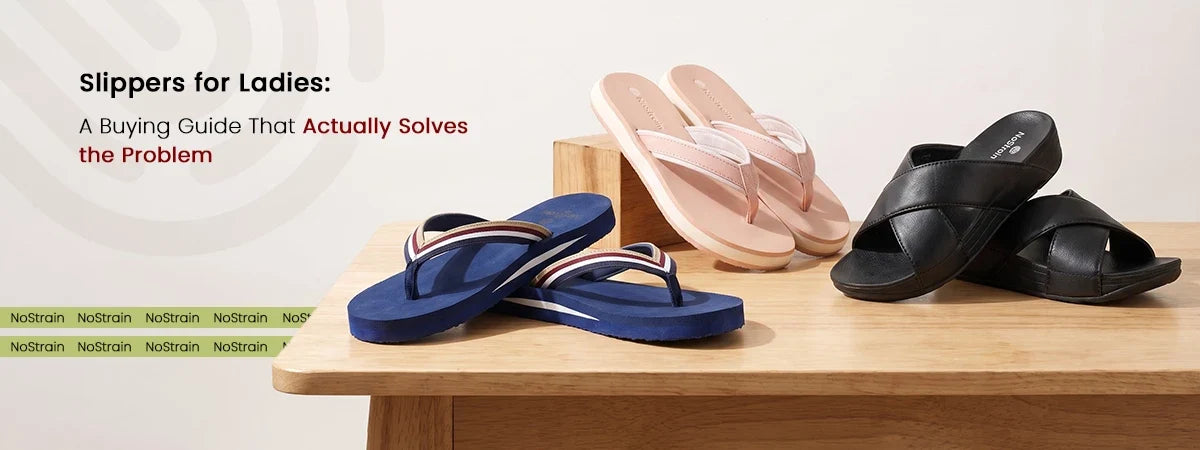
Slippers for Ladies: A Buying Guide That Actually Solves the Problem
Good slippers for ladies have three things most cheap pairs skip: a sole that doesn't go flat in six weeks, a strap or footbed shape that keeps your foot from sliding forward, and enough grip to be safe on wet tile. Price tells you almost nothing about which pair does this. Sole density and strap construction do.
That's the short answer. The rest of this guide covers why most slippers fail on exactly these three points within a season, and how to check for the difference before you buy — whether you're shopping slippers for women for daily home use, hunting for real arch support, or trying to find a pair that won't slip when your kitchen floor is wet.
Why do slippers go flat so fast?
Most budget slippers use a single-density EVA foam sole. It feels soft in the store and compresses permanently within 6 to 8 weeks of daily wear, because there's only one layer doing all the cushioning work. A triple-density sole splits that job across three foam layers of different firmness, so the top layer stays soft against your foot while the bottom layer resists compression. That's the actual mechanical reason one ₹499 slipper outlasts another.
If a listing doesn't mention sole construction at all, assume single density.
Is walking barefoot at home actually bad for your feet?
Podiatrists generally say yes, and the data on Indian feet backs a related point in the other direction: a cross-sectional study on Indian children found that those who grew up wearing sandals or slippers developed stronger, higher arches than children who wore closed shoes, and flat feet were less common among the slipper-wearing group. Separate research puts flatfoot prevalence at roughly 16% in men and 12% in women. None of this makes slippers a medical treatment. It means the surface and support under your foot for the hours you're home matters more than most people assume, especially on Indian flooring — tile, marble, and stone conduct impact straight up through a bare foot with nothing to absorb it.
This is the real case for arch-support slippers over flat foam ones: not comfort alone, but the actual load on your foot over a full day at home.
What should you check before buying slippers for ladies?
Six things, checked in this order:
- Sole layers. Press the sole between two fingers. A single spongy layer will flatten fast; two or three distinguishable layers of firmness will hold shape longer.
- Strap stitching. Pull the strap where it meets the sole. Glued-only straps separate within months; stitched-and-glued straps hold.
- Arch shape. Run a finger along the footbed. A flat footbed offers zero support regardless of how soft it feels. A footbed with a raised curve under the instep is doing actual work.
- Grip pattern. Flip the slipper over. A smooth or worn-looking sole pattern means poor wet-floor grip from day one.
- Toe room. Your longest toe should sit about a thumb's width from the front edge, not touching it.
- Weight. Pick it up. A heavier, denser sole usually means more durable foam, not always more comfort, but it's a fast durability signal.
Fabric, rubber, or leather: which slipper suits your floor?
| Material | Best for | Weak point |
|---|---|---|
| Canvas / fabric upper | Bedrooms, carpeted areas, cool weather | Absorbs water, slow to dry |
| Rubber / EVA | Kitchens, bathrooms, balconies, monsoon | Less breathable over long hours |
| Cork or leather-look footbed | All-day indoor wear, work-from-home | Costs more, needs dry storage |
| Jacquard or woven strap | Casual outdoor errands, daily use | Straps wear faster than solid straps |
If you only own one pair, rubber or EVA with a textured sole covers the most ground in an Indian household — it survives a wet bathroom floor and a quick trip to water the balcony plants without falling apart.
How many pairs of slippers does a woman actually need?
Two, realistically, not the five a slipper haul video might suggest.
- One indoor pair — soft footbed, fabric or jacquard upper, for bedroom and carpeted floors.
- One wet-area pair — rubber sole, quick-dry material, for kitchen, bathroom, and balcony.
A third, sturdier outdoor pair makes sense if you regularly step out for errands or walk the dog, but it's optional for most households. Buying five thin pairs instead of two well-built ones is where most people overspend on slippers for ladies without noticing.
What's the real difference between angular and arch-support slippers?
Angular slippers use a single wide strap across the foot and a flatter, lightweight sole — built for quick slip-on comfort and daily casual wear. Arch support slippers build a raised contour into the footbed itself, aimed at people who stand for long stretches, work from home at a desk, or deal with mild foot fatigue by evening.
Neither is objectively better. Angular slippers suit someone who wants something light to slip on between rooms. Arch-support pairs suit someone whose feet actually ache by 6 PM. NoStrain's Maroon Self Design Jacquard Arch Slippers (AS21) and the Black Angular Slippers (AN15) are a good side-by-side example of that split — same brand, same price bracket, genuinely different jobs.
Do slippers for ladies need to be waterproof?
Only for specific rooms and specific months. A bedroom slipper doesn't need to be waterproof. A kitchen or bathroom pair does, and during monsoon, a rubber or EVA pair that dries fast and won't grow odour matters more than how it looks. We've covered this in more depth in our waterproof slippers guide for women, including which soles actually resist slipping on wet tile versus which ones just claim to.
How do you make a pair of slippers last longer?
Wipe fabric uppers with a barely-damp cloth rather than soaking them — synthetic straps hold water and start smelling if they don't dry fully between uses. Let rubber soles air-dry flat, not stacked, so the shape doesn't warp. Rotate two pairs instead of wearing one daily; foam recovers its shape better with a rest day. Store them out of direct sun, since UV exposure is what actually cracks rubber soles over time, more than regular wear does.
What should slippers for ladies cost in India?
Fabric and jacquard slippers with a decent triple-density sole typically run ₹499 to ₹699. Arch-support and leather-look pairs sit closer to ₹999 to ₹1,999. Below ₹400, expect single-density foam and glued-only straps — fine for occasional use, not for daily wear. NoStrain's under-999 collection covers most of the arch-support and angular range at that mid-tier price point, which is where the durability-to-cost ratio actually works out.
How do you measure your foot for the right slipper size?
Two steps, and both take under a minute.
- Place your foot on a plain sheet of paper and mark the distance from your heel to your longest toe with a scale or ruler. That's your foot length in centimetres.
- Add 1 cm (about 0.5 inch) to that number. That gives you the recommended footbed length — slippers need a little extra room the foot itself doesn't, so the strap doesn't press against your toes.
Match that footbed length against the NoStrain women's size chart below.
| Size | UK | US | EU | Length of footbed | Recommended size length |
|---|---|---|---|---|---|
| 3 | 3 | 5 | 36 | 23 cm | 22 |
| 4 | 4 | 6 | 37 | 24 cm | 22.7 |
| 5 | 5 | 7 | 38 | 25.2 cm | 23.7 |
| 6 | 6 | 8 | 39 | 25.7 cm | 24.3 |
| 7 | 7 | 9 | 40 | 26.7 cm | 25.3 |
Note: the length listed in centimetres is the length of the footwear itself, not your bare foot measurement.
This is also why NoStrain's women's slippers and sandals run true to size for most feet, but sizing up half a size helps if you're between two sizes or have a slightly wider foot — the footbed length column above makes that call easy instead of guessing.
What mistakes do people make buying slippers online?
Three come up constantly in return and exchange requests.
Trusting the photo over the spec. A slipper photographed on a clean white background looks the same whether the sole is single-density foam or triple-density. Scroll to the product description or size chart before the images; that's where sole construction actually gets listed, if it's listed at all.
Ignoring the size chart because "slippers run true to size." They don't, consistently. A jacquard strap slipper and a rubber slide from the same brand can fit half a size apart because the strap material stretches differently. Check the size chart per product, not per brand.
Buying the cheapest option in a multi-buy deal. Multi-pair discounts are genuinely useful, but only if every pair in the set is one you'd buy on its own. Adding a third pair purely because it drops the price of the first two usually means a slipper that sits unused after week one.
A fourth, smaller one: skipping the return policy before ordering. Foot width varies more than most people expect, and a slipper that looked right in the photo can still pinch across the widest part of the foot. Buying from a seller with a clear, working exchange process removes most of the risk that comes with sizing footwear online.
Ladies ke liye slippers kaise choose karein?
Ghar ke istemal ke liye do jodi rakhna sahi rehta hai — ek soft, fabric wali indoor ke liye, aur ek rubber sole wali jo kitchen aur bathroom mein safe rahe. Sole ko finger se dabakar dekhein, agar woh turant flat ho jaye toh woh jyada din nahi chalegi. Strap ki stitching bhi check karein, sirf glue se joda hua strap jaldi nikal jaata hai.
NoStrain's slippers for women, in short
Every pair in the slippers for women range carries BIS/ISI-certified quality control, which matters more than it sounds — it means the sole material and construction meet a fixed Indian standard rather than varying batch to batch. The range splits into three practical categories: angular slippers for lightweight daily wear, arch-support slippers for anyone on their feet most of the day, and waterproof slippers for kitchen, bathroom, and monsoon use. If sliding on and off matters more than straps, the sliders for women collection covers that too.
Pick based on your floor and your day, not the photo. A slipper that photographs well but goes flat in a month costs more per wear than a plainer pair that holds up for a year.
Slippers for ladies: quick answers
Are fabric slippers or rubber slippers better for daily use? Fabric for indoor, carpeted rooms; rubber for kitchens, bathrooms, and any wet floor. Most households need one of each rather than picking a single winner.
How do I know if a slipper has real arch support or just a curved shape? Press your thumb into the footbed under where your arch sits. Real support pushes back; a soft dip with no resistance is just a moulded shape, not support.
Can I wear the same slippers outdoors and indoors? Not ideally. Outdoor use wears down grip and picks up dirt that indoor floors don't need. A separate outdoor-rated pair with a firmer sole handles that better.
Why do my slippers smell after a few weeks? Trapped moisture in the strap or footbed lining, usually from wearing them barefoot in humid weather without letting them fully dry between uses. Rotating two pairs fixes most of this.
What size should I pick if I'm between sizes? Measure your foot length, add 1 cm, and match it against the size chart above. If you land between two sizes, go up rather than down for fabric and jacquard slippers, since the straps don't stretch much.
Do arch-support slippers help with existing foot pain? They reduce strain during the hours you wear them; they don't correct an existing condition. For ongoing foot pain, an arch-support slipper is a comfort measure, not a substitute for seeing a podiatrist.
Leave a comment
This site is protected by hCaptcha and the hCaptcha Privacy Policy and Terms of Service apply.