

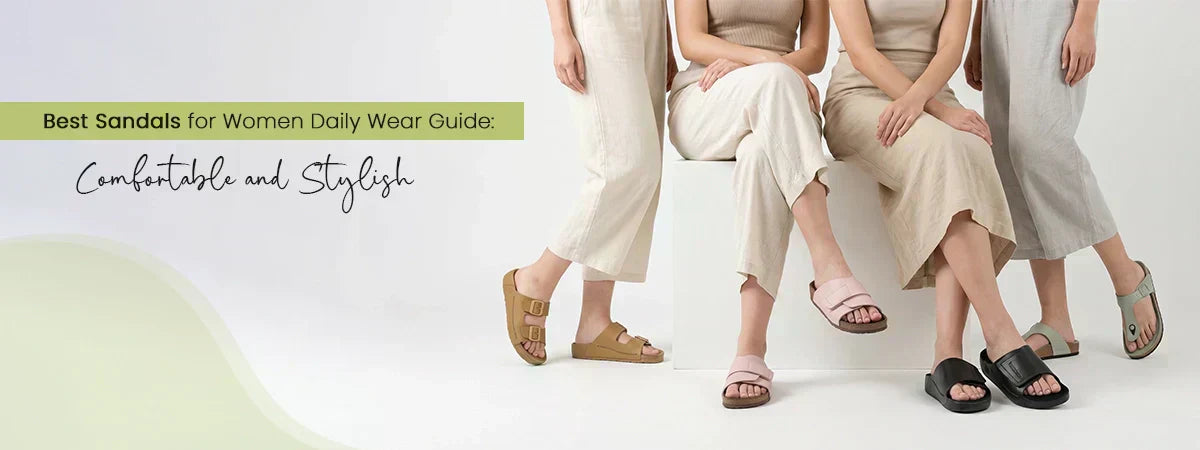
How to Choose Comfortable Sandals for Women: Foot Type and All-Day Wear Guide
Comfortable sandals for women have a contoured footbed that follows the arch, a cupped heel, straps you can adjust and a sole with grip. Match the footbed to your day: leather arch support for long walks, cork for standing, a broad strap for wide feet. Start with NoStrain's sandals for women and filter by footbed.
Key takeaway: Choose the footbed first and the look second. A plain sandal with arch support and a heel cup will feel better at 6 pm than a pretty flat one with neither.
What makes a sandal comfortable for women?
A comfortable sandal does four jobs: it supports the arch, holds the heel in place, keeps the foot from sliding forward and grips the floor. Softness alone isn't enough. A very soft, flat footbed feels good in the shop and tired by evening, because the foot works harder to stay stable.
Check these five things before you buy any pair:
- Arch contour. Press your thumb into the middle of the footbed. There should be a raised curve under the inner arch, not a flat sheet.
- Heel cup. The back of the footbed should dip and rise at the edges so the heel sits in a shallow bowl.
- Adjustable straps. Hook-and-loop or buckle straps let you loosen the fit when feet swell in Indian summers.
- Outsole grip. Turn the sandal over. A zigzag or ridged pattern grips wet tiles and marble better than a smooth base.
- Weight. Lift the pair. A heavy sandal on a long day adds strain with every step.
The first two checks matter most and are the ones most budget sandals skip. Straps and grip are easier to find.
Which sandals are best for walking all day?
For long walks, pick a flat or low sandal with a firm arch contour, a heel cup and a strap behind the heel. The back strap stops the heel from lifting out on every step, so your toes don't have to grip. A flexible outsole with tread helps on uneven pavements and wet market floors.
Sandals without a back strap can still work for short errands. For a full day of sightseeing or a wedding where you'll be on your feet, the back strap is the feature to insist on.
The back-strap leather arch support sandals follow this pattern. They have a pure leather upper, a suede leather insole with arch support built into a cupped heel, a zigzag PU outsole and hook-and-loop straps at the front and back. The product page rates them 4.8 out of 5 across 4 reviews (November 2026), a small sample but a useful early sign.
Which sandals work for standing all day?
For standing, you need even pressure across the whole foot more than bounce. A cork footbed suits this well, because cork is firm, shapes itself to your foot over the first few weeks of wear and spreads your weight. Add an adjustable strap so the foot stays centred on the footbed through the day.
Teachers, salon staff, shop owners and anyone at a counter for hours will notice the difference most in the heel and the ball of the foot. Standing still loads those two spots, and a flat rubber sole gives them no help.
The parallel black cork sandals combine a cork and rubber footbed with a real suede leather insole and two adjustable Velcro straps. They hold a 4.9 rating from 18 reviews, and reviewers on the page mention the arch support, the breathability and a footbed that moulds to the foot.
Cork takes a little time to settle. Wear a new pair for a few hours a day in the first week before a full shift.
How do you choose sandals for your foot type?
Start with your arch, then your width. Wet your sole, step on paper or a dry tile and check the print. A full print with little inner curve means a low arch. A thin strip between heel and forefoot means a high arch. A wide forefoot print means you need roomier straps.
Flat feet or low arches
Look for a footbed with a clear raised contour under the inner arch and a deep heel cup. Avoid completely flat chappals for long wear. NoStrain's leather arch support range is described on its product pages as suited to flat and normal feet.
High arches
High arches need cushioning under the heel and the ball of the foot, since less of the sole touches the ground. A cork or cushioned footbed works better here than a hard, rigid contour. Make sure the strap sits higher on the instep and can be loosened.
Wide feet
Broad straps spread pressure across the top of the foot, and narrow straps dig in. Pick hook-and-loop closures so you can set the width yourself, and check that the footbed is wide enough that your little toe doesn't hang over the edge.
The broad strap leather arch support sandals are built for this. They have one wide pure-leather strap with a hook-and-loop closure, a cupped heel with arch support and a zigzag PU outsole.
Leather, cork or wedge: which footbed suits your day?
| Footbed type | Feels like | Best for | Watch out for |
|---|---|---|---|
| Leather with arch support | Firm contour, smooth suede top | Long walks, office, travel | Needs spot cleaning; not for soaking |
| Cork | Firm at first, moulds to the foot | Standing jobs, daily wear | Takes a week or so to break in |
| Cushioned wedge | Softer, raised heel | Events, short outings, adding height | Less stable on uneven ground |
| Flat rubber or EVA | Soft, light | Home, rain, quick errands | Little arch support for long hours |
Most women end up with two pairs: a supportive pair for long days and a lighter pair for home or rain. If your long days are mostly at a workplace, our piece on sandals for long work hours covers office and shift wear in more detail.
Heel height is a smaller factor than the footbed. A low wedge with a cushioned, contoured insole can feel better over a day than a flat sandal with a bare, flat sole. Height starts to matter once the foot slides forward and the toes press against the front strap.
Which should you choose: leather arch support, cork or wedge?
It depends on how your day splits between walking, standing and sitting. Leather arch support sandals suit women who walk the most, cork suits long hours on your feet in one place, and a cushioned wedge suits events where you sit more than you walk. Use the lists below to match your own routine.
Choose leather arch support sandals if:
- you walk a lot, commute on foot or travel
- you have flat feet or low arches and want a firm contour
- you need a neater look for the office
Choose cork sandals if:
- you stand for hours at work or at home
- you want a footbed that shapes itself to your foot
- you have high arches and need more even cushioning
Choose a cushioned wedge if:
- you want some height for events or ethnic wear
- your day involves more sitting than walking
For the first case, the full range of arch support sandals for women is grouped in one place, with flat, back-strap, buckle and broad-strap designs.
How do you care for comfortable sandals so they stay comfortable?
Comfort fades when the footbed flattens or stays damp. Spot-clean leather with a soft damp cloth, never soak it, and air-dry away from direct sun. For cork, wipe the upper, clean the insole gently and keep the cork away from long soaking. Replace a pair once the heel cup collapses or the tread wears smooth.
Rotate between two pairs if you wear sandals every day. A footbed that gets a day to dry out keeps its shape and smell longer.
A few habits make a pair last through more seasons:
- Loosen the straps before you take the sandals off, so the hook-and-loop doesn't wear out early.
- Store them flat, not piled under other footwear, so the heel cup keeps its shape.
- Keep leather pairs out of the monsoon and use a waterproof pair on wet days.
The full step-by-step routine for leather pairs is in the leather sandal care guide.
Frequently asked questions
How do I know if a sandal is the right length?
Your heel should sit fully inside the heel cup and your toes should stay on the footbed without touching the front edge. If your toes hang over or your heel sits on the back rim, try the next size.
Should new sandals feel tight?
They should feel snug, not painful. Leather straps soften with wear and hook-and-loop straps can be loosened. A cork footbed feels firm at first and settles to your foot over the first week or two.
Can I wear arch support sandals if my feet are normal?
Yes. A moderate arch contour supports a normal arch as well as a low one. NoStrain's leather arch support sandals are described on their product pages as suited to both flat and normal feet.
Are wedges better than flat sandals for standing all day?
Not on height alone. What matters more is the footbed. A low wedge with a contoured, cushioned insole can beat a flat sandal with a bare sole, but a high wedge pushes weight onto the forefoot over a long day.
When should I replace my sandals?
Replace them when the heel cup has flattened, the arch contour no longer presses back, the tread has worn smooth or the straps no longer hold. Comfort drops before the sandal looks worn out.
Leave a comment
This site is protected by hCaptcha and the hCaptcha Privacy Policy and Terms of Service apply.